PM Modi’s Gold Boycott: Economic Masterstroke or Market Crisis? | Khabar For You
- Khabar Editor
- 11 May, 2026
- 97724
Email:-infokhabarforyou@gmail.com
Instagram:-@khabar_for_you

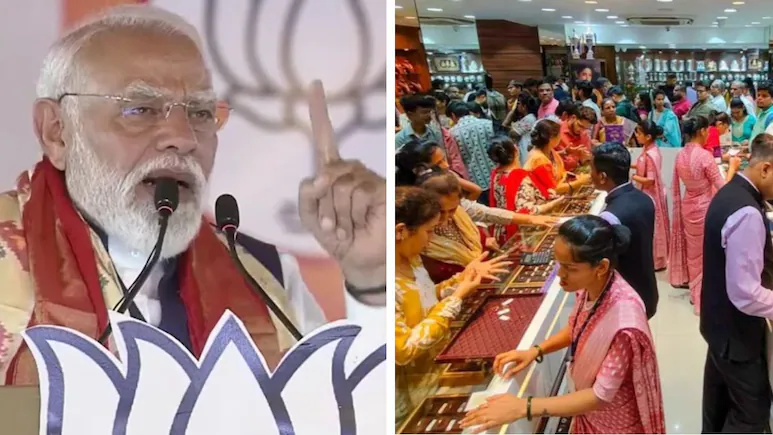
In a move that has sent ripples through the domestic bullion markets and sparked intense debate over the nation’s economic resilience, Prime Minister Narendra Modi has made a direct, unprecedented appeal to the citizens of India: "Resolve not to purchase gold for at least one year."
Addressing a massive public gathering in Secunderabad on Sunday, the Prime Minister framed this austerity measure as a "national duty" in the face of a deepening global crisis. The appeal comes at a time when the conflict in West Asia shows no signs of abating, pushing crude oil prices higher and exerting severe pressure on India’s foreign exchange (forex) reserves.
Read More - Bengal Political Crisis 2026: Mamata Banerjee Dissolves Assembly
‘Sankat Ka Kaal’: A Call for Patriotic Austerity
Characterizing the current global geopolitical climate as a *“sankat ka kaal”* (time of crisis), the Prime Minister urged Indians to adopt a lifestyle of "self-reliance" to safeguard the economy.
“You are witnessing the challenges across the world. The crisis in West Asia is continuing, and the impact of the war is being felt globally. Bharat is also affected by this situation,” PM Modi said, according to reports from DD News.
The Prime Minister’s "pledge" for the nation includes more than just gold. He called for a drastic reduction in the consumption of fossil fuels, the postponement of non-essential foreign travel, and even a reduction in the use of chemical fertilizers by farmers. However, it is the call to boycott gold - a metal deeply intertwined with Indian culture, weddings, and savings - that has hit the hardest.
The Math Behind the Appeal: Forex Under Fire
The economic rationale behind the Prime Minister's request is stark. India is the world's second-largest consumer of gold, and nearly all of it is imported. In the financial year 2024-25, gold imports surged to a staggering $51.5 billion, accounting for roughly 7.2% of India's total import bill.
As global crude oil prices remain volatile due to the Iran-Israel tensions, India’s forex reserves have felt the heat. While the reserves reached a historic high of over $700 billion in September 2024, recent weeks have seen a sharp decline. In the week ending May 1, 2026, reserves fell by $7.79 billion to $690.69 billion.
By asking citizens to stop buying gold, the government aims to plug a significant drain on foreign currency. "Every gram of gold we buy is paid for in dollars," explained a senior official from the Finance Ministry. "When we combine the high cost of oil with massive gold imports, our rupee comes under immense pressure."
Market Meltdown: Jewellery Stocks Tank
The impact of the Prime Minister’s speech was felt almost instantly on Dalal Street. As markets opened on Monday, the BSE Sensex plummeted by over 950 points, while the Nifty 50 dropped by 1.14%.
The most severe damage was visible in the jewellery sector. Shares of major players reacted with alarm:
Senco Gold Limited: Dropped 8.98%
Titan Company Limited: Fell 5.34%
Kalyan Jewellers: Decreased by 7.43%
"The sentiment is one of shock," said a Mumbai-based bullion trader. "Gold isn't just a luxury here; it’s a hedge against inflation. If the Prime Minister is telling people not to buy it even for weddings, it sends a signal of extreme economic caution."
The Middle-Class Dilemma
For the average Indian household, the Prime Minister's request poses a moral and financial dilemma. In India, gold is the traditional "safety net." With the wedding season approaching, many families are left wondering how to proceed.
"We have been saving for my daughter's wedding for years," said Ramesh Gupta, a small business owner in Delhi. "If the PM says it's for the country, we want to listen. But what do we give as a gift? What happens to our savings if the rupee falls further and we didn't buy gold when we could?"
The Prime Minister’s speech also touched upon a return to "Work From Home" (WFH) and the use of electric vehicles to save fuel. This suggests a broader strategy to pivot the Indian economy away from import-heavy consumption patterns.
The Geopolitical Shadow
Experts suggest that the Prime Minister’s urgency stems from the "tail risks" of a re-escalation in West Asia. The ongoing tensions between Israel and Iran threaten the Strait of Hormuz - a vital artery for India’s energy supplies.
Banking and market expert Ajay Bagga noted, “The PM is focusing on the energy supply and price challenges. Expectation of petrol and diesel price hikes this week are high as Oil Marketing Companies (OMCs) are running losses of ₹30,000 crores per month.”
A Gamble on Patriotism?
This is not the first time the Modi government has appealed to the public’s sense of duty to solve an economic problem - the "Give It Up" campaign for LPG subsidies being a prime example. However, asking a nation to give up its "Gold Obsession" is a much larger gamble.
If successful, the move could stabilize the rupee and provide a crucial buffer for the forex reserves. If it fails, it could lead to an increase in gold smuggling or a loss of consumer confidence in the economy.
For now, the bullion markets remain in a tailspin, and the nation waits to see if the "Sankat Ka Kaal" will be met with the "complete submission" the Prime Minister has called for.
© 2023 Khabar For You. All Rights Reserved.
Business, Sports, Lifestyle ,Politics ,Entertainment ,Technology ,National ,World ,Travel ,Editorial and Article में सबसे बड़ी समाचार कहानियों के शीर्ष पर बने रहने के लिए, हमारे subscriber-to-our-newsletter khabarforyou.com पर बॉटम लाइन पर साइन अप करें। |
| यदि आपके या आपके किसी जानने वाले के पास प्रकाशित करने के लिए कोई समाचार है, तो इस हेल्पलाइन पर कॉल करें या व्हाट्सअप करें: 8502024040 |
#KFY #KFYNEWS #KHABARFORYOU #WORLDNEWS
नवीनतम PODCAST सुनें, केवल The FM Yours पर
Click for more trending Khabar
Leave a Reply
Your email address will not be published. Required fields are marked *
Search
Category